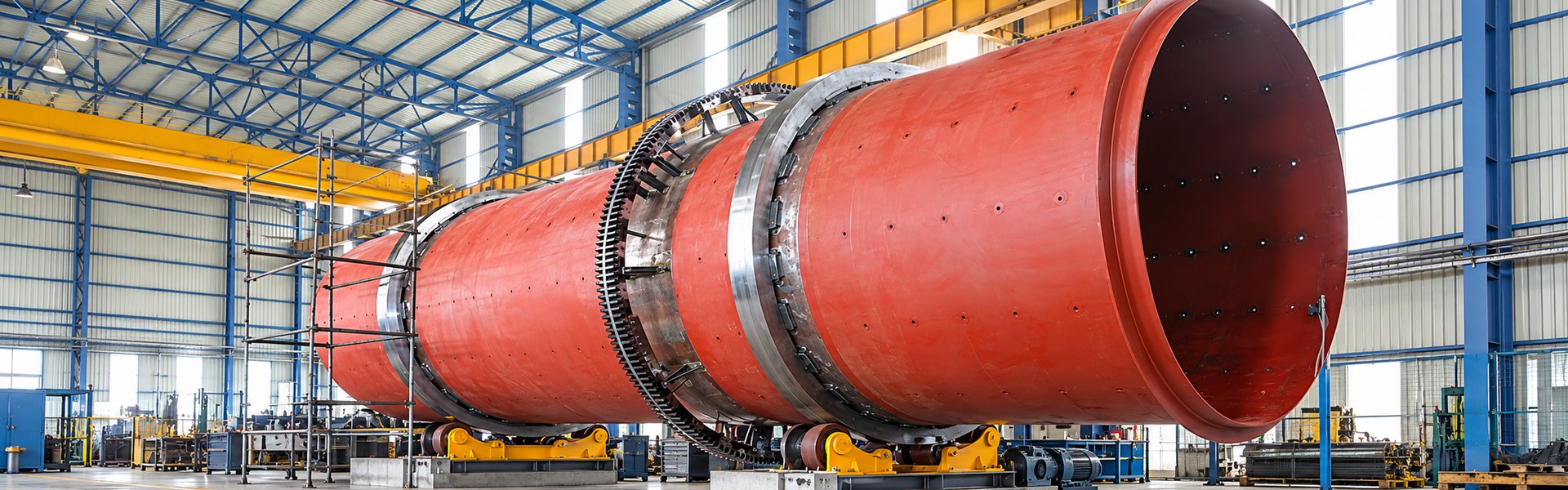
Rotary Dryers
A rotary dryer is a slowly rotating, gently inclined cylinder that removes moisture from wet solids by cascading them through a stream of heated gas. Alongside the rotary kiln, it is a mainstay of continuous solids processing.
As the shell turns, internal flights lift the material and shower it through the gas stream so each particle is repeatedly exposed to dry, heated air. The result is an even, controllable moisture reduction across the whole feed — something a fixed bed or a simple conveyor cannot match.
How a rotary dryer works
Wet feed enters at the higher end and travels the length of the drum by rotation and a slight downward slope. Hot gas moves through the drum either with the material (co-current) or against it (counter-current), evaporating moisture while the flights keep the material tumbling and airborne. Dried product discharges at the far end, and the moist exhaust gas passes through a dust collector before release.
Direct and indirect drying
Direct-heated (convective) dryers bring the hot gas into direct contact with the material. They dry quickly and suit heat-tolerant solids such as sand, minerals, biomass and wood chip.
Indirect-heated (conductive) dryers heat the drum wall externally and transfer heat through the shell, keeping the process gas separate from the product. They are used where the material is dusty, solvent-laden or reactive, or where evaporated vapour must be recovered.
Co-current and counter-current airflow
Co-current moves gas and material in the same direction, so the hottest gas meets the wettest feed and the material surface temperature stays limited — ideal for heat-sensitive feeds.
Counter-current moves gas against the material, exposing the nearly-dry product to the hottest gas to drive moisture to a lower final level and make fuller use of the heat.
Where rotary dryers are used
- Minerals and aggregates — sand, gravel, ore, fertiliser and chemical salts.
- Biomass — wood chip, sawdust, bark and agricultural residue dried before pyrolysis, gasification or pelletising.
- Sludges and wastes — sewage and industrial sludge, and waste-derived feedstocks prepared for thermal treatment.
- Food and agriculture — grains, seeds and by-products.
Why a rotary dryer
A rotary dryer accepts coarse, sticky, lumpy and variable feed that would clog other dryer designs. Its gentle tumbling gives a uniform product, its seals tolerate surges, and its simplicity keeps capital and operating costs predictable at industrial scale. It also pairs naturally with a rotary kiln: a dryer upstream removes moisture so the kiln downstream spends its heat on the reaction, not on boiling water away.
Dryers engineered by RotaryKilns.com
We design, engineer, fabricate and install rotary dryers and kilns as integrated thermal-processing plants. A dryer is frequently positioned ahead of a pyrolysis or gasification kiln to pre-dry the feed, raising throughput and thermal efficiency across the whole line. We size the drum, slope, rotation speed, flights, heating mode and gas-handling system from your material and capacity, then deliver the dryer as a standalone unit or as part of a complete plant.